Back to Plays

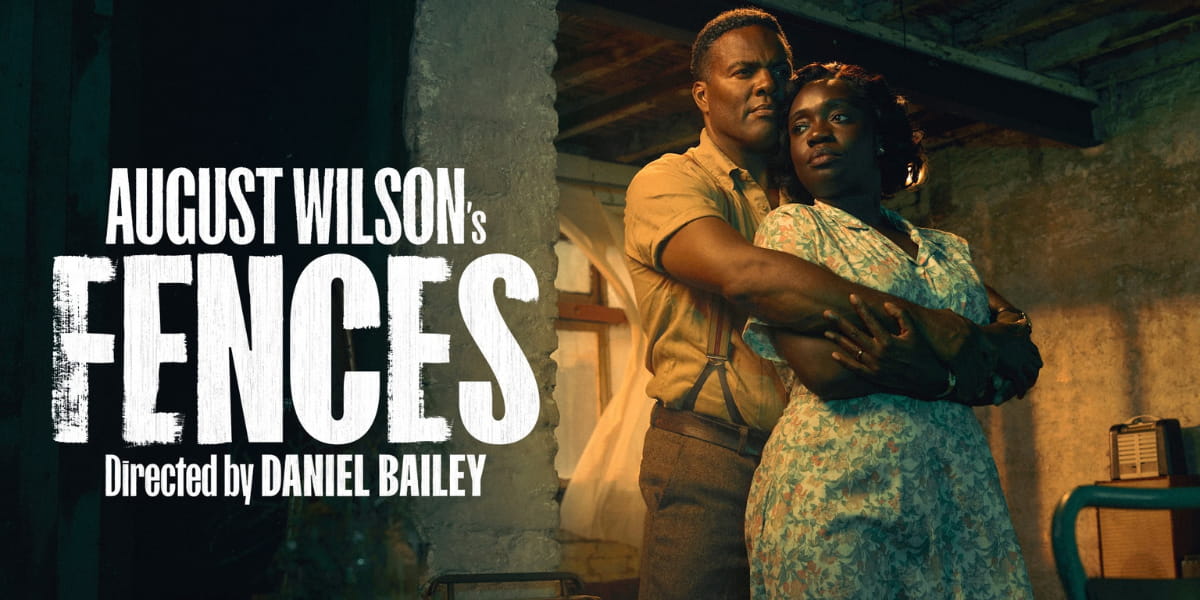
August Wilson’s Fences Tickets

A powerful American family drama about legacy, limits and what’s passed down.

Fences is most suitable for ages 12+. Under 14s must be accompanied by a full paying adult.

Performance Dates

6 - 31 October 2026

Run time: 3 hours

Includes interval

5

1 reviews

  • Show info
  • Performance Times
  • Gallery
  • Accessibility
  • Reviews
  • News

‘Some people build fences to keep people out, and other people build fences to keep people in.’

Troy Maxson has cheated death once, but the past keeps closing in. On Pittsburgh’s streets, he cracks jokes and spins stories, yet at home, the pressure is building.

His wife, Rose holds the family together. She sees a changing world and hopes their son Cory might step into it with more freedom than Troy ever had. But when dreams collide, and tempers flare, the Maxson’s edge towards a reckoning that could reshape everything they know.

August Wilson’s landmark play, set in the 1950s, returns in a vital new production directed by the award-winning Daniel Bailey (Red Pitch, West End). From one of America’s most influential 20th century writers, this is a story of ambition for our time.

This production is generously supported by Charles Holloway OBE.

The Lyric’s 2026 Season is supported by Mark & Sarah Crosbie.

Upcoming Performance Times

Monday12 October 2026
Tuesday13 October 2026
Wednesday14 October 2026
Thursday15 October 2026
Friday16 October 2026
Saturday17 October 2026
19:30
19:30
14:30
19:30
19:30
19:30
14:30

Performance Months

Jump directly to a month to select a performance

August Wilson's Fences at the Lyric Hammersmith Theatre

Content

The story contains themes of death, injury, and implied sexual assault. There is occasional strong and racially explicit language, including use of the n-word.

Access

Captioned Performance: 22 October at 7.30pm 2026 BSL Performance: 26 October 2026 at 7.30pm Audio Described Performance: 24 October 2026 at 2.30pm

Recent Reviews

5.0
1 reviews

Latest August Wilson’s Fences News

August Wilson’s Fences Review: A Powerful Portrait of Family, Prejudice and Masculinity

News / Reviews / Features / New Shows + Transfers

August Wilson’s Fences Review: A Powerful Portrait of Family, Prejudice and Masculinity

Written in 1985, August Wilson’s Fences is part of his American Century Cycle, a landmark series of ten plays exploring Black American life across each decade of the 20th century. Set in 1950s Pittsburgh, it follows Troy Maxson, a garbage collector whose promising baseball career was cut short by racial discrimination. Having spent 15 years in prison before building a life for himself, Troy takes immense pride in providing for his family, but his own disappointments begin to shape the future he imagines for his wife, Rose, and teenage son, Cory. When Cory attracts the attention of a college football recruiter, the prospect of a future his father could never achieve brings their conflicting ideas about ambition, race and responsibility to the surface. Despite its three hour running time, Fences never feels unnecessarily long. Every scene feels purposeful, as August Wilson gradually peels back the layers of an apparently ordinary family, revealing the resentments, disappointments and long-held wounds beneath the surface. There is something almost soap-opera-like about it: you feel as though you are peering into real people’s lives, where domestic routines are charged with tension, and seemingly minor disagreements expose much deeper under currents.  There are shades of Arthur Miller in its portrait of a working man wrestling with his place in the world, his disappointments and the legacy he will leave behind. Yet Wilson’s achievement is entirely his own, rooted in the Black experience of 1950s America and the racism that shapes every aspect of his characters’ lives. His writing is funny, lyrical and brutally perceptive, exposing not only the discrimination faced by Black men but also the inequalities experienced by Black women within their own families. Ray Fearon is extraordinary as Troy. His performance is a gut punch, capturing the contradictions of a man who is at once charismatic and cruel, wounded and controlling. Fearon makes us understand how Troy’s experiences of racism and disappointment have shaped his worldview, without ever losing sight of the damage he inflicts on those around him.  Troy has spent his life fighting against a world that has limited his opportunities, and he is determined that his family should understand the harsh realities he has learned to navigate. But his desire to protect them is inseparable from his pride, bitterness and need to dictate their futures. His resistance to Cory’s ambitions is not simply a wish to see his son fail; it is the product of a man who cannot imagine a different outcome from the one life has taught him to expect. Wilson constantly shifts the balance between our sympathy for Troy and our frustration with him. We understand the world that has shaped his bitterness, but we also see how he reproduces its inequalities within his own home, demanding obedience from his wife and son while exempting himself from the very responsibilities he expects them to honour. Wilson is equally incisive about Troy’s treatment of Rose, played beautifully by Madeline Appiah. He demands loyalty and obedience from his wife while giving himself permission to escape the responsibilities he imposes on everyone else. His infidelity exposes the double standards underpinning his authority, as well as the fragile ego beneath it. When the affair is revealed, the audible gasp from the audience says everything. Appiah brings real weight to Rose, making the cost of Troy’s choices devastatingly clear.

12 Oct, 2026 | By Hay Brunsdon

Lyn Gardner's Weekly Picks

News / Features / New Shows + Transfers / Lyn Gardner

Lyn Gardner's Weekly Picks

Head over to the Lyric Hammersmith for Daniel Bailey’s revival of Fences, August Wilson’s Pulitzer Prize-winning play, set in the 1950s, about failed black baseball player Troy Maxson, who now works as a garbage collector. It’s a big, soapy family drama about how parents can help their children to grow or stunt them because they can’t let go of their own disappointments. Wilson charted the lives of African Americans through the 20th century in a series of richly textured plays constructing the histories of people whose lives had been overlooked and just dismissed as unimportant. Both on and off stage. Wilson made those lives sing, and he is arguably America’s most important 20th-century playwright. Give this a go; it’s deceptively meaty and knotty.  Understanding the past in order to make a future was also the purpose of the political theorist Hannah Arendt, who coined the phrase ‘the banality of evil” in 1961 while covering the trial of Nazi war criminal Adolf Eichmann. Eichmann managed the logistics of the mass deportation of millions of Jews to the Nazi death camps but insisted he was just “following orders". Arendt had expected to find herself face-to-face with a monster but found an ordinary man who had simply never examined his actions. Opening at the Arcola this week, Julia Pascal’s The Banalities of Evil: Hannah Arendt, France, 1940 focuses on an earlier episode in Arendt's life when, in France, she was arrested as an undesirable and sent to a camp. The experience shaped her thinking as a historian and philosopher.   

5 Oct, 2026 | By Lyn Gardner

Lyn Gardner's Top Ten Reasons to See Fences at the Lyric Hammersmith

News / Features / New Shows + Transfers / Lyn Gardner

Lyn Gardner's Top Ten Reasons to See Fences at the Lyric Hammersmith

Fences is a magnificent family drama written by the remarkable US playwright August Wilson, the great chronicler of African American life during the 20th century. Imagine King Lear rewritten as a soap drama and relocated to 1950s Pittsburgh, where Troy Maxson is a man who believes he could have been a contender if his career as a professional baseball player had not been thwarted by the colour of his skin. Flawed, complex and bruised, Troy works as a garbage collector, and instead of encouraging his own sons, just as the civil rights movement is beginning to grow, he seems to be doing his best to blight their opportunities, just as his were blighted.  So Troy is no hero. Wilson has written a fascinating psychological portrait within a play which is both epic and soapy, the latter in the best possible way. It’s a story which grips as it picks up the stone of family life and finds what is lurking underneath. It has a forensic quality.  It’s a drama that comes garlanded. It won four Tony’s for its premiere in 1987 (including Best Play), and it also scooped a Pulitzer Prize. Wilson was only the third African-American to win. So definitely not to be sniffed at. Wilson himself said of the play—hugely influential on many playwrights, including UK ones such as Roy Williams—that “although there are no white characters in Fences, the white world is very much there, because the white world exerts a pressure on that family from the outside. Racism is a part of Black life in America. So if you are going to write about Blacks, you have to write about racism, because that is part of their lives.” He does it with no holding back but also real delicacy.  The Lyric Hammersmith production—directed by Daniel Bailey with an adept jazz-inflected approach—already comes with some rave reviews from its Leeds Playhouse run. By all accounts, Ray Fearon as Troy really delivers. He is “horribly compelling as this tragic figure, a man made monstrous by circumstance," proclaimed the Times, while the Stage was full of admiration for Fearon’s physicality: “His fists become projectiles as his swinging arms strike spots in the air.” 

2 Oct, 2026 | By Lyn Gardner

More News
Tickets from£16.50
Book Tickets